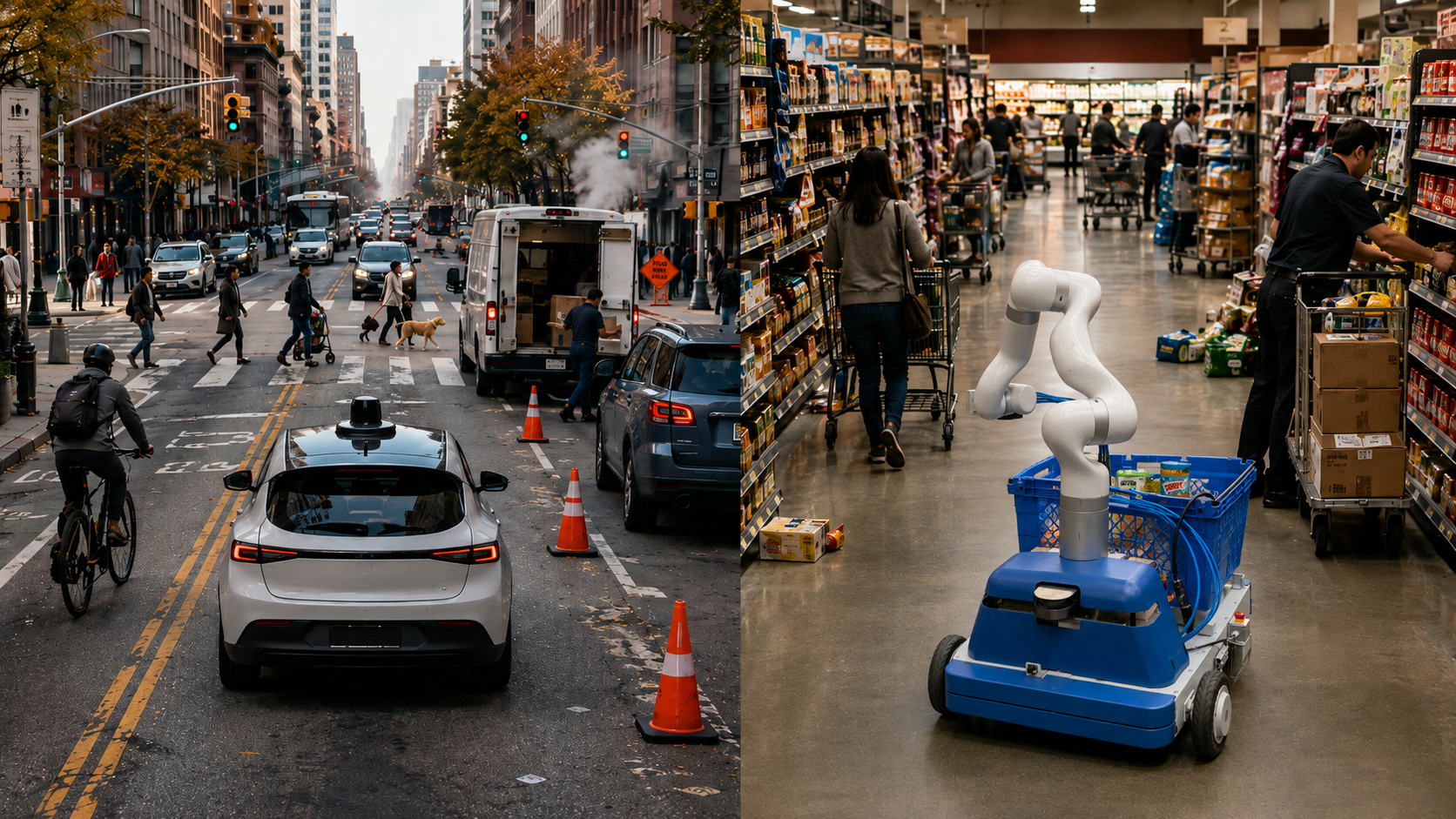
For most of robotics history, robots have lived behind fences – welding arms bolted to factory floors, shuttles racing through distribution centers. They succeed because the environment was engineered for them. The world’s largest e-commerce operator began deploying warehouse robots in 2012 and by 2025 had passed one million robots, but inside 300+ purpose-built facilities where it controls every shelf, marking, and traffic lane. The environment bends to the robot.
A new generation of robots now operates in “the wild”: streets, sidewalks, skies, hotel corridors – unstructured environments built for people, with jaywalkers, strollers, spills, and shopping carts. Here the robot must adapt to the world. Blue Collar Robotics belongs to this generation: our robots pick online grocery orders inside live supermarkets, alongside shoppers, during store hours.
The wild has been conquered before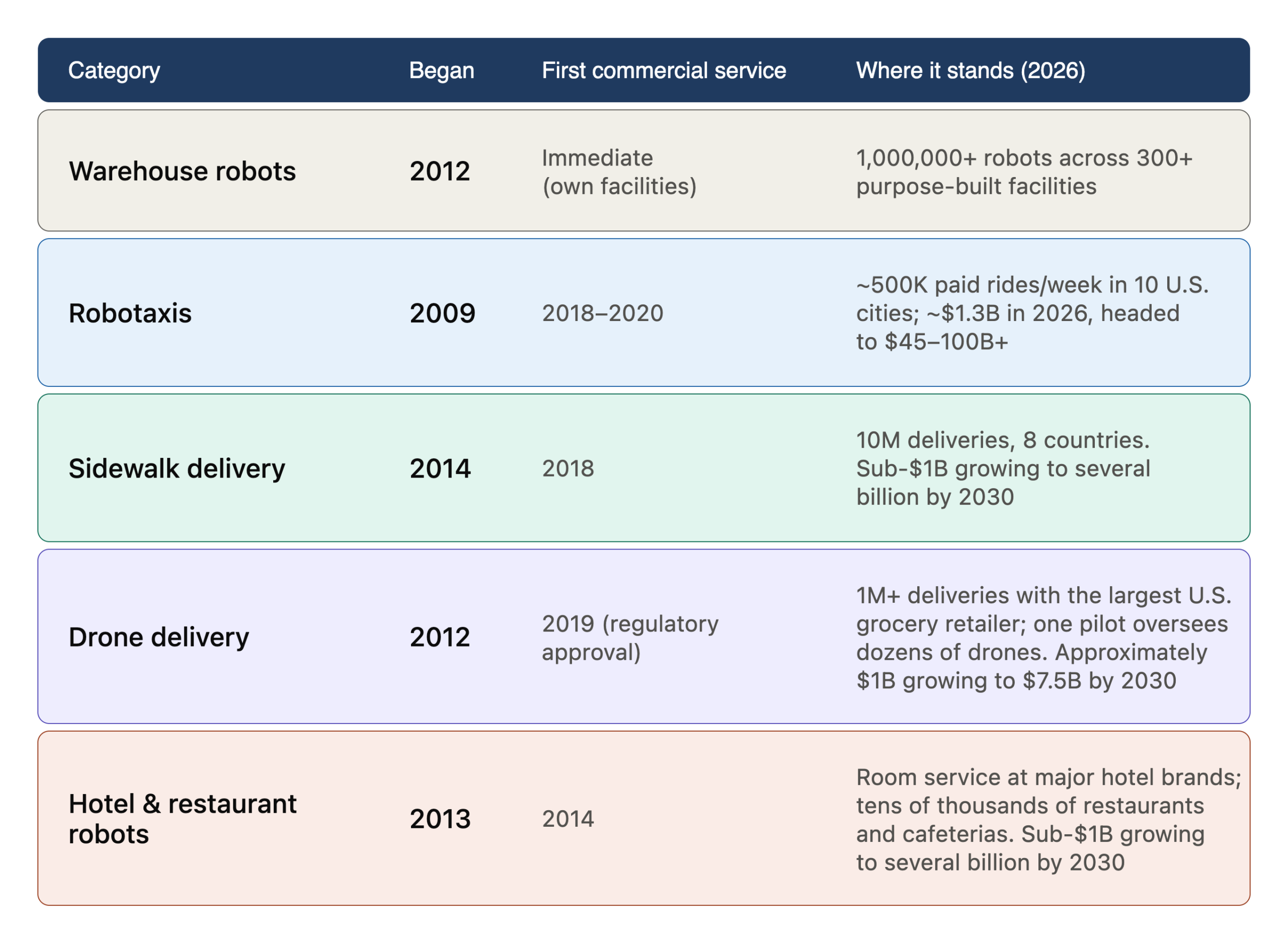 The pattern: the pioneers spent a decade-plus and hundreds of millions to billions of dollars each proving robots can earn a living among people, because they had to invent everything: sensors, autonomy software, operating playbooks, even regulations. That tuition has now been paid. Companies deploying today inherit mature components, proven teleoperation practices, and a public already comfortable sharing space with robots.
What the winners have in common
- Remote operation as the bridge to autonomy. Nearly every successful deployment relies on remote operators who supervise fleets and handle edge cases – one sidewalk player even launched fully teleoperated, earning revenue while collecting the data that later enabled autonomy. Deploy a commercial service today; let every intervention teach the system.
- Purpose-built machines in a bounded domain. Winners design hardware for the job – a steering-wheel-free vehicle, a cooler-sized sidewalk robot and master one campus or metro before replicating.
- Robotics-as-a-Service economics. Customers pay for outcomes – rides, deliveries, picks – not machines, while cost per task falls as autonomy rises.
- The data flywheel. Every mile, crossing, and order compounds into training data that widens the moat. In physical AI, deployment is the R&D.
The markets are enormous. E-Grocery is no exception.
Each category is supported by a large underlying market. The global robotaxi market is estimated at approximately $1.3 billion in 2026 and is projected to reach $45–100+ billion in the 2030s. Delivery robots are also growing from a small base into a multibillion-dollar market.
Blue Collar Robotics operates within the approximately $250 billion U.S. online grocery market. Our addressable opportunity is not the full value of grocery sales, but the substantial fulfillment-cost pool embedded within that market.
In-store picking remains largely manual and is typically the largest online fulfillment expense. Picking and related labor can cost approximately $8–$10 per order, consuming much of the margin on a typical online grocery basket.
Why e-Grocery is a new frontier
Most robots operating in the real world today – robotaxis, drones, delivery robots, and hotel runners – are navigation devices. They move people or payloads from point A to point B without physically changing their environment.
Our robot adds an arm, and that changes everything. Navigation gets the robot to the work; manipulation allows it to perform the work. It must identify a specific object, determine how to grasp it, remove it safely, and place it without damage.
E-Grocery is the ideal frontier for this capability. A robot must navigate a busy grocery store, then pick one item from tens of thousands of SKUs and place it into the correct order.
The first wave of robotics taught machines to move through the physical world. The next wave will teach them to work within it. That is the frontier Blue Collar Robotics is building.
Why we’ll get there fast
The first wave took a decade because it had to invent the wild. We don’t. Shared autonomy from day one – AI-assisted robots backed by trained remote operators – delivers reliable picks now at a cost per pick that beats manual labor, while every assisted pick trains the vision-language-action models that progressively automate the job. And we build automotive-style: sourcing mature, production-proven components – sensors, drives, compute, batteries – and integrating them into a machine purpose-built for grocery aisles. Development cycles measured in months, hardware reliable on day one, costs that follow proven supply chains. Delivered as Robotic Labor-as-a-Service: retailers pay for picks, not robots, so our incentives are identical – drive cost per pick down, relentlessly.
The robots have left the cage. Now they’re ready to roll down aisle seven.