Since 1895, at least 1,900 automobile companies were formed in the United States, producing more than 3,000 makes of cars. By 1908 there were 253 active manufacturers. By 1929, 44. By the end of that decade, three companies: Ford, GM, and Chrysler. All produced roughly 80% of the industry’s output.
The graveyards of Detroit and Pittsburgh are full of brilliant engineering. V-shaped radiators. Racing trophies. Patented transmissions. What killed those 1,900 companies was almost never bad engineering. It was economics: they poured capital into designing everything themselves, never reached the volumes to justify it, and ran out of investors before they found a market.
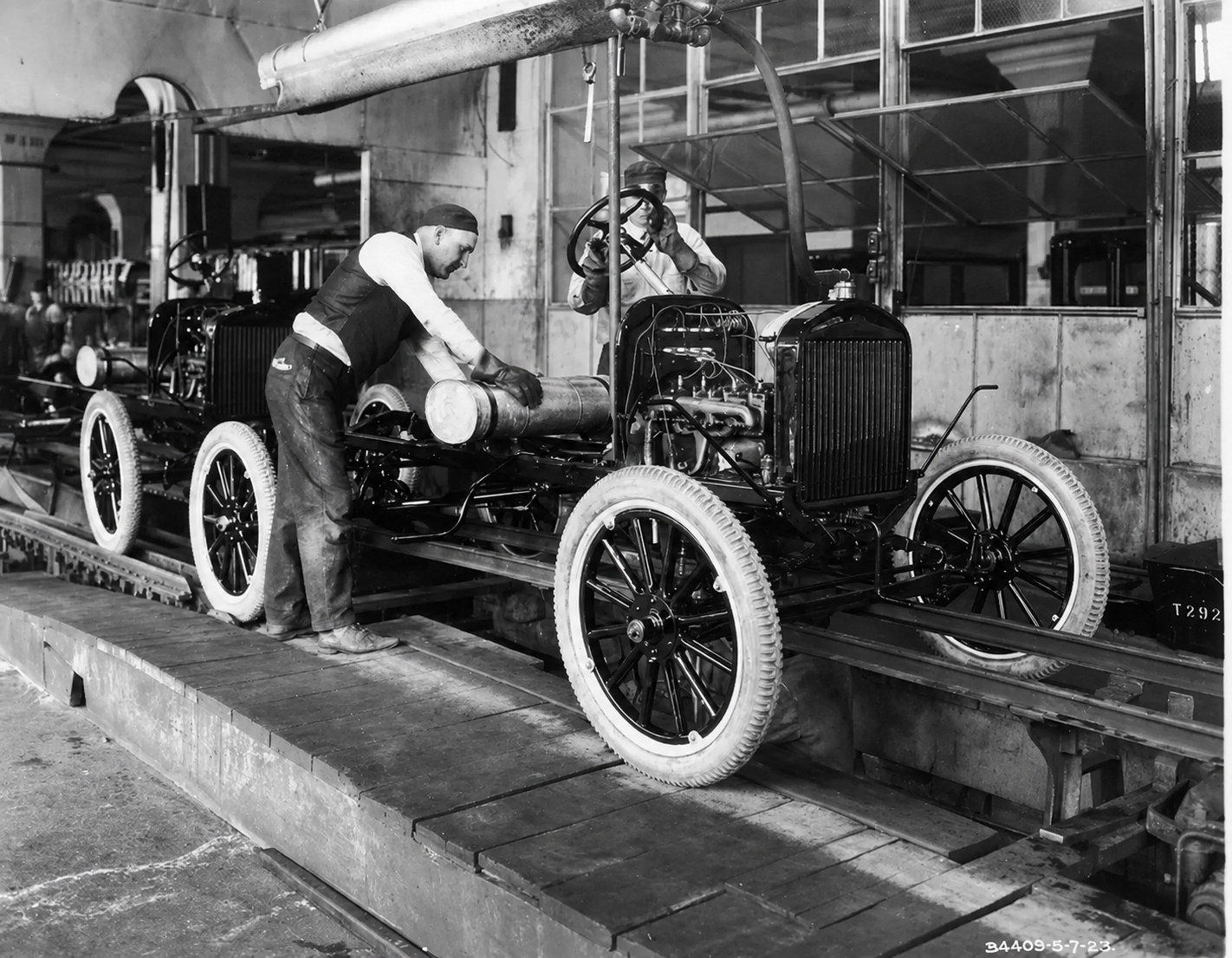
Now look at who won. In 1903, the Ford Motor Company was capitalized with $28,000 and owned almost no component technology. The Dodge brothers supplied the entire chassis for Ford’s first cars – engine, transmission, axles. Ford added the body and wheels. By today’s vocabulary, Henry Ford was running a “thin tech” company.
What Ford owned was not the components. It was the customer, the product concept, and the manufacturing process that matched a machine to a mass market – perfect product-market fit. The deep engineering lived in the supplier base: Timken bearings, A.O. Smith frames, Champion spark plugs, Dodge drivetrains. The winners sat on top of that supplier base and assembled purpose-built machines for markets they understood just as Blue Collar Robotics is doing today.
Vertical integration came later, and only for the winners. Ford built River Rouge after the Model T proved demand in the millions. Durant bolted suppliers onto GM at scale, and nearly bankrupted the company twice doing it. Among the survivors, integration always followed market ownership. It never preceded it.
The humanoid industry is running the 1905 playbook
Today, more than a hundred humanoid robot companies are each designing their own actuators, their own hands, their own “intelligence.” Billions of venture dollars are in, and total commercial deployments across the entire industry number in the low thousands. Sounds familiar?
Meanwhile, the supplier base is forming in plain sight, and it’s forming fast:
Shenzhen is now emerging as a hub for robotic components: arms, hands, servo motors, and controllers are being localized and cost-compressed at speed. Teardowns show up to a tenfold gap between supplier prices and those in-house manufactured actuators which are the single largest cost block in any robot. Cost compression is coming, and it will accrue to whoever *buys* components, not whoever spent five years and $200 million designing their own. Even the “brain” is becoming a catalogue part when leading AI companies are offering robot foundation models openly to any builder.
Purpose-built machines are solving a problem. Humanoids are looking for a market
A general-purpose humanoid is a machine in search of a job. A purpose-built robot is a machine solving a real-world problem.
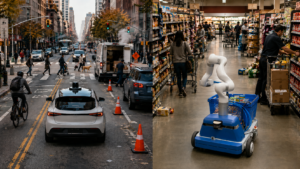
In grocery fulfillment, Blue Collar Robotics’ market, no customer can afford to pay for bipedal locomotion when simple wheels are sufficient. No customer can afford five-fingered hands when a simple suction cup efficiently picks packaged goods. Customers pay for items picked per hour at a cost below their current labor cost, deployed in the stores they already own. Purpose-built means we carry zero cost for capabilities the customer doesn’t need, and we win on the only spec sheet that matters: the customer’s P&L.
There’s a compounding difference too. The humanoid companies are compounding component IP, an asset that commoditizes as the supplier base matures. We are compounding customer relationships, deployment data, and operating know-how in a specific vertical which are assets that appreciate as components get cheaper. Every dollar the supply chain takes out of actuator costs makes their IP worth less and our installed footprint worth more.
So yes, Blue Collar Robotics is thin tech in the same way Ford was thin tech in 1903. Light on component R&D, because that layer commoditizes. Heavy on market access, unit economics, and the unglamorous work of making robots earn money in real stores, because that layer compounds.
Ford bought his chassis from the Dodge brothers, yet the Model T was one of the most original engineering achievements of its era – vanadium steel, a transmission a farmer could operate, a design ruthlessly matched to its market. The parts were purchased. The product was invented. That’s exactly where we sit. Our first targeted industry is in-store e-grocery fulfillment, and design and engineer purpose-built machines to win in it.
The robotics industry will end up looking like the automotive industry: a deep supplier base underneath, and on top of it, purpose-built machines engineered by companies that understand a market. When the shakeout comes, as it always does, you have to pick a layer. Go deep on components and sell to the whole industry, or go deep on a market and build the machine that earns money in it.
We picked our layer. We engineer purpose-built robots targeting industry verticals.