One year ago today, after months of planning, Vish, Yağmur, and I met to formally kick off Blue Collar Robotics. We shared one fundamental conviction:
Robotics should expand human productivity, unlock economic growth, and increase the value of blue-collar work.
Computers, software, the internet, and now artificial intelligence have dramatically increased the productivity of white-collar workers. We believed robotics could do the same for people who perform physical work. That required designing a company around humans from day one. Rather than engineering people out of the system, we engineered them into our service – placing them on an ever-increasing productivity curve where automation steadily increases their output, capabilities, and ultimately their value.
Vish had seen ambitious robotics projects collapse when full autonomy was treated as a prerequisite for deployment. Yağmur saw the possibility of democratizing physical work by enabling people to perform it remotely, regardless of where they live. I had spent years watching labor shortages constrain growth across manufacturing, agriculture, and retail. In developed economies, significant opportunities go unrealized simply because there are not enough people willing or available to do repetitive physical work.
That reality defined our entry market. E-grocery in-store fulfillment is the #1 constraint limiting further growth of a massive market. Many grocery retailers who bet on centralized automated fulfillment centers were left managing the problem back in their stores. They did not need another new fulfillment center with a new name. They needed a solution that fits into the warehouses they already have: their stores.
Year One had one job
We were ambitious about the long-term opportunity and deliberately modest about what we needed to prove first. Year One had a single objective: build a minimum viable product, put it in front of industry experts and customers, and determine whether both the problem and our approach were real.
I funded that stage myself. Starting any new technology company is high-risk. Robotics multiplies the challenge – hardware, software, supply chain, safety, reliability, customer integration, and capital intensity all at once. Plenty of talented teams had already attempted robotic grocery picking without producing a scalable commercial solution. Belief is not validation. I did not want outside capital at risk until we had shown that our team could design, build, and operate a picking robot and that customers wanted it.
We did what we set out to do. From our kickoff on August 10, 2025, we designed, built, and operated our first robot and had it ready to demonstrate by November 10. In parallel we did the necessary homework on the problem itself. We analyzed more than 40,000 supermarket SKUs item by item and found that roughly 65% of a typical supermarket’s assortment is addressable with our approach. I worked as a picker for a month inside a Smith’s (Kroger) store in Utah to understand the complete in-store fulfillment process. That hands-on experience, combined with the SKU analysis, directly shaped product design and every customer conversation that followed.
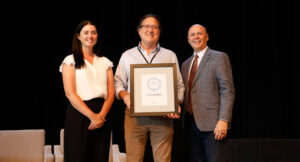
We then took the robot to market, showed it to industry experts and grocery executives, listened carefully, and learned. The response delivered the validation we sought. Conversations turned into genuine interest. Industry recognition followed. Customers began reaching out to us. Today that interest has matured into active engagements with several of the largest grocery retailers in North America and internationally.
Two decisions that shaped our architecture
We started with two hard-won lessons from earlier attempts at grocery robotic picking.
First: do not try to pick everything. The physical world contains nearly unlimited variation. Solving every object, shape, orientation, and exception before entering the market is a path to endless development. We narrowed the problem to packaged grocery products – boxes, cans, bottles, jars, and bags- where both the environment and the manipulation task can be constrained.
Second: do not make full autonomy a prerequisite for deployment. This was our most frequently challenged decision. Throughout the year we heard the same question in different forms: “Teleoperation isn’t really robotics. When will the robot be fully autonomous?” Our answer remains unchanged: full autonomy is a destination, not the admission ticket to the real world.
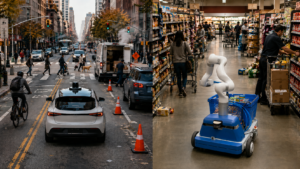
From our automotive experience we knew the autonomy trap well. Companies have spent more than a decade, enormous capital, and billions of miles of data, yet real-world autonomous driving still relies heavily on supervision or constrained environments. That does not prove autonomy is impossible; it proves how difficult the real world is. Navigation plus manipulation raises the bar even higher. Before a robot can learn how humans handle thousands of unusual situations, those examples must be generated. That is why we designed Blue Collar Robotics around human-in-the-loop operation and progressive autonomy from the beginning. A remote operator handles what the robot does not yet understand. Those interactions become training data. Repeated tasks are progressively automated. One operator eventually supervises multiple robots. The critical distinction is that our robots do not wait in a laboratory for autonomy to arrive. They work today while generating the data required for greater autonomy tomorrow – data earned through actual, revenue-generating work.
Interestingly, in recent months the broader robotics industry has moved significantly toward the position we started with. Teleoperation, human demonstration, and large-scale collection of physical-world training data are now central to how the field thinks about embodied AI. The tide has shifted.
AI as an accelerant
There is an element of timing for which we deserve little credit. When we started, we understood that artificial intelligence would matter. A year later we realize we dramatically underestimated both its importance and its speed. Vision models, reasoning models, robot foundation models, and simulation are advancing rapidly, and those tools are available to a small company. We began building the physical platform at precisely the moment the intelligence available to operate it began accelerating. We could not have planned the timing better.
We build robots the way the automotive industry builds vehicles
One structural advantage deserves mention because it explains how a small team designed, built, and iterated real hardware this quickly on limited funding.
Yağmur and I come from automotive. We first worked together in China standing up a new heavy-truck manufacturing plant to localize production of a global flagship truck. Between us are decades of experience taking vehicles and components from drawing to production with the launch discipline, supplier development, quality systems, and cost engineering the industry demands.
We brought that DNA into Blue Collar Robotics. We do not reinvent components that mature industries have already perfected. We source proven, production-grade motors, drives, batteries, actuators, and robotic arms and integrate them into a purpose-built machine, the way automotive platforms are engineered. Every part is designed for manufacturability and cost from the first sketch, because we are not building demonstrations. We are building a product that must eventually be produced in the hundreds of thousands at economics that work for customers. That is also why we established a capital-light manufacturing model from day one, partnering with a leading Utah university advanced-manufacturing center to produce our first commercial units while we build our operational foundation.
The people who joined the journey
No company like this is built by founders alone. In our first year we were fortunate to attract people whose experience materially strengthened the company.
We first drew world-class engineers from our global network, then grew with exceptional Utah talent. The consistent filter was simple: people who understand the scale of what we are building, believe in how we are building it, and intend to stay for the long-term vision. That clarity has kept our original team intact.
Bill Bennett joined as a strategic advisor after a career spanning grocery, retail, e-commerce, and consumer products, including leading e-commerce at Kroger. He had seen the large investments grocery retailers made in centralized automated fulfillment and the limitations those approaches create when significant order volume still must be fulfilled from existing store networks.
Paul Harker joined as a strategic advisor with deep experience in grocery retail and the Australian market. He reinforced a critical insight: retailers want to continue using their stores as local fulfillment assets, yet the labor economics of e-grocery remain difficult.
Both joined because the problem is not theoretical. It is one grocery retailers are living with every day. Their experience sharpened the conviction that now anchors our strategy: the store is not going away. For much of grocery, the store remains the closest inventory point to the customer. The opportunity is not to build another highly automated warehouse. It is to make the existing retail network dramatically more productive.
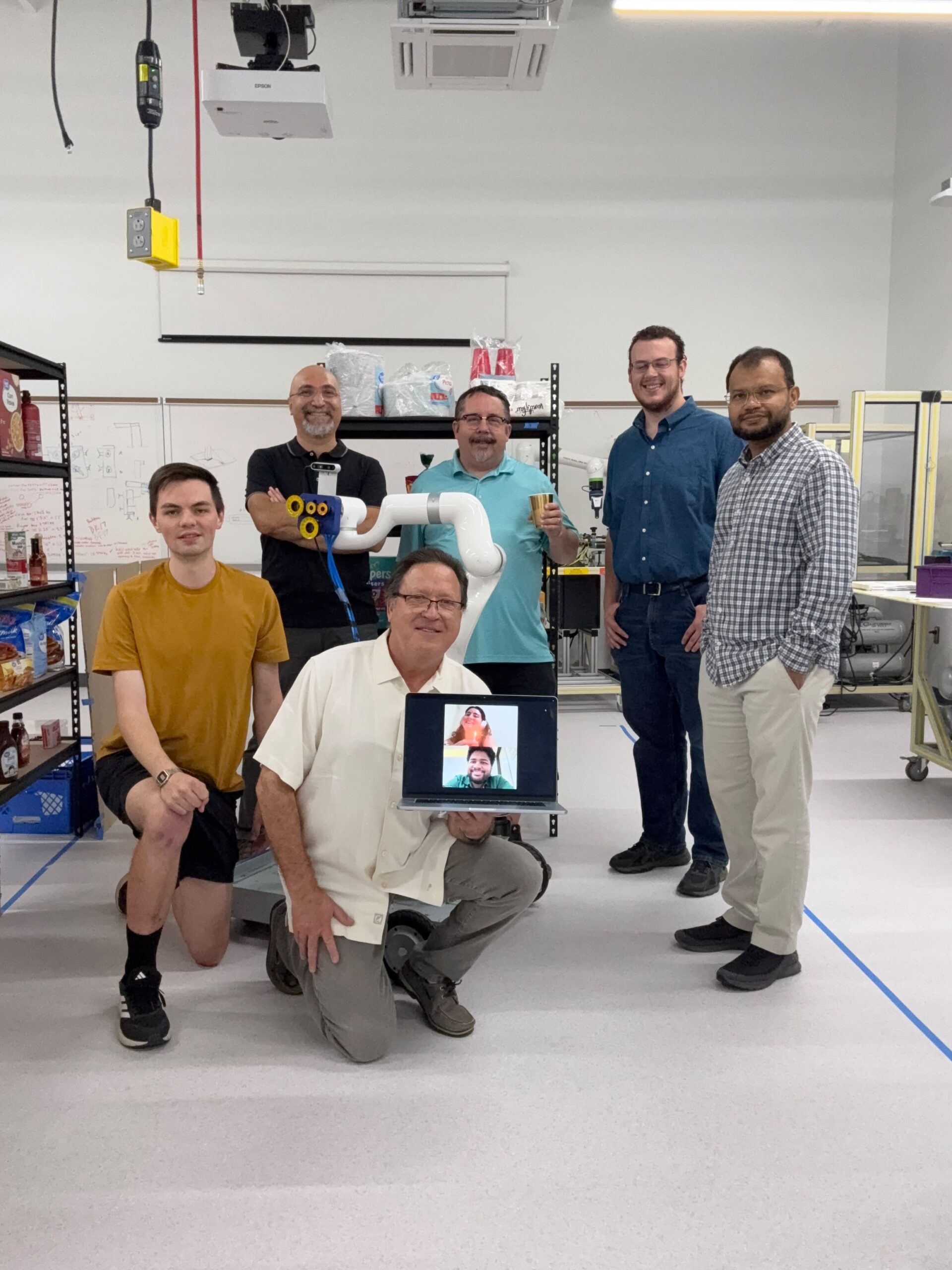
Blue Collar Robotics Co-Founders & Engineering Team, Ogden, Utah, August 10, 2026
From MVP to commercial product
Our first robot did exactly what it needed to do. It proved we could build and operate the system, enabled real customer engagement, and generated the feedback that defined the commercial product.
We are now building Gen 2 – the first version designed directly around what we learned from grocery customers and industry experts. It is purpose-built for in-store grocery fulfillment: higher picking productivity, batch picking of multiple orders, improved mobility and manipulation, better remote operation, and progressively greater autonomy. Most importantly, it is engineered for commercial economics measured the way our customers measure them – in cost per pick.
The first Gen 2 units are in production now for paid customer trials in the fourth quarter. Those trials will validate remaining design assumptions, refine integration with customer operations, and prepare us for broader pilots and ramp-up. In parallel we are building the full business around the robot: remote operations, supply chain, manufacturing, customer integration, service capability, and a continuous program to drive product cost lower as we scale. We are building a robotics business first. Every decision to date has been made against the requirements of a durable corporation.
We also learned we were thinking too small
One of the more surprising developments of the first year has been the speed of product/market fit. We expected technology validation to be the hard part and commercial adoption to follow gradually. Instead, serious customer opportunities are developing faster than anticipated.
Grocery remains our wedge and in-store e-grocery fulfillment the market we intend to win first. Focus still matters. But growing demand means self-funding alone is no longer the responsible path. For the first time we have begun raising outside capital – not to discover whether there is a business, but to support the business that customer validation has already begun to reveal. We are speaking with investors who understand both parts of what we are building: a focused company attacking the economics of in-store grocery fulfillment today, and a larger mission to use robotics to raise the productivity and earning power of physical labor tomorrow.
The mission remains the same
A year ago we wrote that Blue Collar Robotics exists to answer a simple question: how do you move labor around the world when people themselves cannot move? Our answer was to deliver labor through the internet. That answer has not changed. What has changed is our confidence that the underlying idea can become a real business.
A year ago Blue Collar Robotics was a hypothesis. Today we have a team, a working technology platform, filed patent applications, experienced industry advisors, active engagements with some of the world’s largest grocery retailers, a commercial product in production, and customers preparing to put that product to work.
There is still an enormous amount left to prove. That is the nature of building something new. But Year One did exactly what it needed to do. It earned us the right to begin Year Two and Year Two will be different. The first year was about proving we could build a robot customers want. The next year is about deploying those robots into customer facilities.
I want to thank the Blue Collar Robotics team. Over the past year you turned drawings, code, parts, late nights, disagreements, mistakes, and an idea into something the market is demanding. Through disciplined work and the intelligent use of available tools and resources, we compressed several years of progress into one. Year Two has the potential to compress the timeline even further, allowing us to scale more aggressively than any of us initially imagined.
Happy first anniversary, Blue Collar Robotics.
We’re just getting started.
Hank Crawford, Co-founder & CEO