Every large industry develops assumptions so deeply embedded that they eventually stop looking like assumptions.
In grocery, one of them is simple:
This is simply how an online order gets picked.
Some of the biggest technology opportunities emerge when long-standing assumptions are challenged – not merely to improve an existing process, but to change its underlying economics.
We believe grocery is approaching one of those moments.
The fulfillment model has not kept pace
The consumer experience of grocery has changed dramatically.
Customers can search thousands of products, build a basket, pay, choose pickup or delivery, and track an order from a phone.
The physical process behind that experience has changed far less.
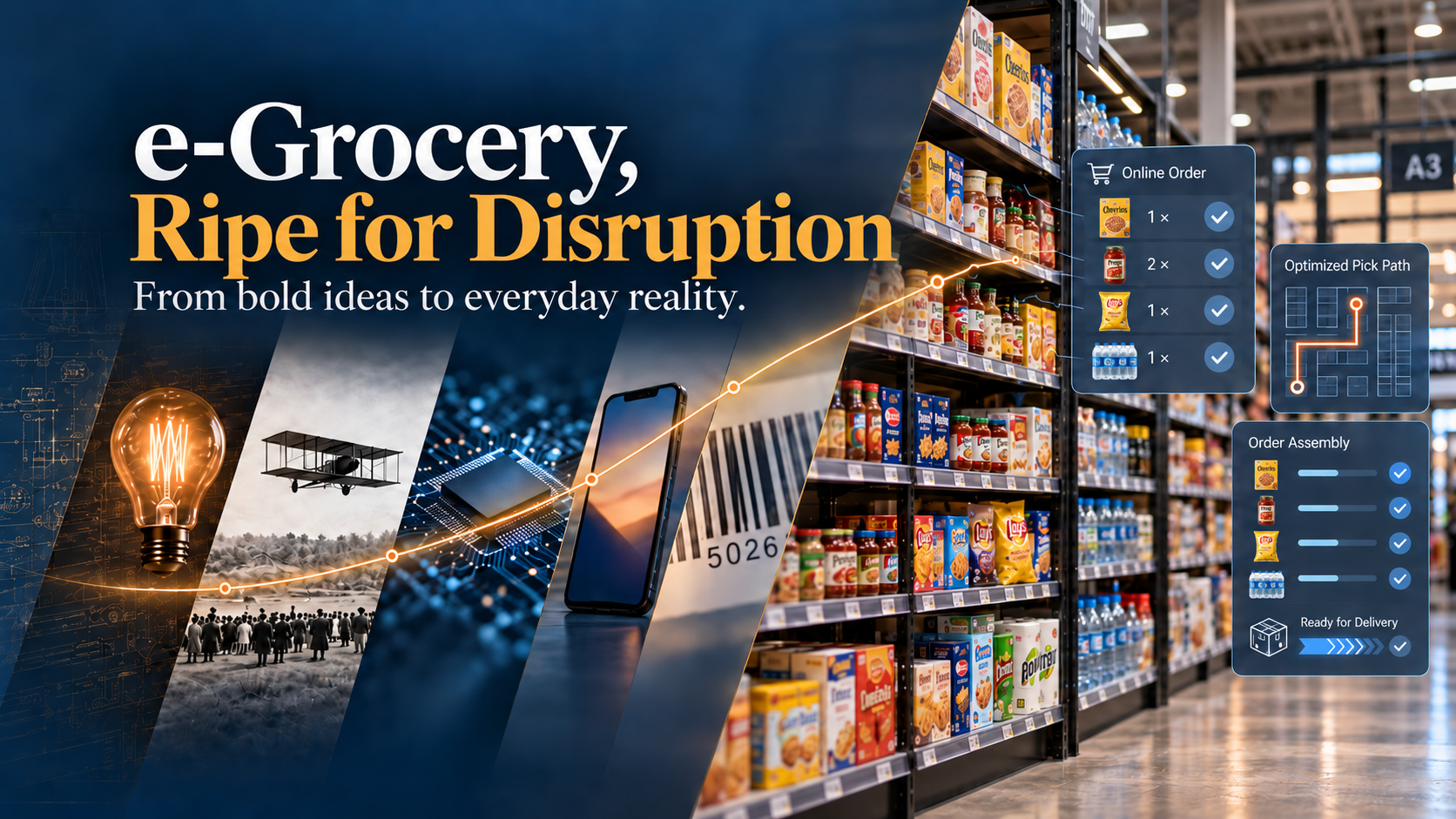
For a large share of store-based fulfillment, a picker still walks the aisles, locates each item, and assembles the order manually.
The order is digital. The fulfillment is still footsteps.
That model helped e-Grocery scale quickly. But as online demand becomes a larger part of the grocery business, the economics of fulfillment become increasingly important.
Demand is outgrowing the operating model
Online grocery is no longer a peripheral channel.
In August 2026, U.S. e-Grocery sales grew 24.9% year-over-year, while average order frequency increased 18%. Sixty percent of U.S. households purchased groceries online during the month.
The question is therefore shifting from whether consumers will buy groceries online to whether grocery retailers can fulfill increasing order volumes economically and at scale.
More online orders create more physical picking activity. Today, much of that work is still performed manually inside stores.
McKinsey’s 2026 grocery analysis found that store-based fulfillment accounts for 57% of e-commerce orders among surveyed grocery retailers. It also found that manual store-based fulfillment tends to encounter capacity constraints as online penetration approaches roughly 12% to 15%.
The underlying challenge is not simply labor availability.
It is how to expand fulfillment capacity without scaling manual picking at the same rate as online demand.
At some point, incremental improvements to the existing process are not enough. The operating model itself has to evolve.
The store is a strategic fulfillment asset
One response has been to move fulfillment into environments designed specifically for automation – centralized fulfillment centers, micro-fulfillment systems, and other purpose-built infrastructure.
Those models can be effective under the right conditions.
But they are not the only way to think about the problem.
Grocery retailers already operate extensive physical networks that combine inventory, replenishment infrastructure, fresh and refrigerated capability, broad assortment, and proximity to consumer demand. Importantly, these stores are already performing a significant share of e-Grocery fulfillment today.
The strategic opportunity, therefore, is not simply to replace store-based fulfillment with an entirely new infrastructure layer.
It is to make the fulfillment infrastructure grocery retailers already have significantly more productive.
Stores were designed primarily for customers to shop in. They were not designed for large volumes of online orders to be picked manually alongside normal store operations.
That creates an important question:
Can automation increase the fulfillment capacity of the store without requiring grocery retailers to rebuild their network around the technology?
That is the opportunity we are pursuing at Blue Collar Robotics.
Build the robot around the store
Traditional automation often achieves efficiency by structuring the environment around the machine.
Grocery requires the opposite approach.
The environment already exists, changes continuously, and must continue serving customers and store associates. Shelves are replenished. Displays move. Products vary widely in size, shape, weight, and packaging. Inventory is not always exactly where expected.
The technology has to adapt to that reality.
Our approach is to design the robot around the store – not the store around the robot.
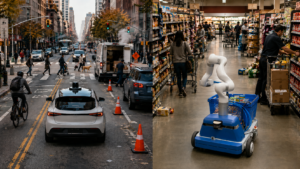
The objective is a system that can operate within existing aisles and workflows, pick everyday grocery products, coexist safely with people, and add productive fulfillment capacity without requiring major changes to a grocery retailer’s physical infrastructure.
That changes the role of the store. It remains a place where customers shop, while becoming a more productive node in the grocery retailer’s e-Grocery fulfillment network.
Why the timing has changed
Until recently, operating robots reliably in an environment as dynamic as a grocery store was extraordinarily difficult.
That is beginning to change.
Advances in machine vision, AI, manipulation, sensing, and computing are making robots increasingly capable of operating in environments designed for people rather than machines.
That technological convergence matters because it makes a class of work that has historically depended almost entirely on manual labor increasingly addressable by robotics.
The opportunity is not automation for its own sake.
It is applying technology where it can meaningfully improve the economics of fulfillment.
The metric that matters is economics
A robot picking an item from a grocery shelf is technically interesting.
But that is not the customer outcome.
The questions that matter are more practical.
Can it lower cost per pick? Increase throughput? Add fulfillment capacity without increasing manual picking at the same rate? Operate safely within existing stores? Scale across a grocery retailer’s network?
Those are the questions that determine whether robotics becomes operational infrastructure rather than a demonstration.
The breakthrough is not simply getting a robot to pick groceries. It is changing the economics of grocery fulfillment.
Grocery is ripe
The conditions are coming together.
Online demand is growing rapidly. Store-based fulfillment remains heavily dependent on manual picking. Grocery retailers already operate extensive networks positioned close to consumers. And robotics is becoming capable enough to work within those environments.
The first era of e-Grocery transformed how consumers place the order.
The next will transform how that order is fulfilled.
Grocery retailers already have the stores, the inventory, the demand, and the fulfillment network.
The opportunity is to make that network dramatically more productive.
E-Grocery is ripe for disruption. Blue Collar Robotics is building the solution that will drive it.