Some numbers are so large they stop meaning anything. A billion dollars is a fortune. A trillion dollars is an abstraction. Forty trillion dollars is a number our minds simply refuse to process – so we round it down to “big” and move on.
That’s a mistake. Because $40 trillion is the number now being attached to Physical AI – artificial intelligence embodied in machines that move, grip, lift, drive, and work in the real world – and the people attaching it to Physical AI are not bloggers or day traders. The CEO of the world’s most valuable company, the chipmaker powering the entire AI revolution, has spent the past year repeating it: humanoid robots and labor automation represent a $40 trillion total addressable market. In some venues he’s gone further and said $50 trillion. Wall Street analysts have started building sector models around it. Morgan Stanley projects humanoid robots alone will be a $5 trillion market by 2050.
So before we dismiss the number as hype, it’s worth asking a different question: what would it take for $40 trillion to be right? And the answer, it turns out, is not complicated.
Where the number comes from
The $40 trillion isn’t a forecast of robot sales. It’s a measure of the work.
More than 2.5 billion people on this planet earn their living through physical labor: driving, lifting, stocking, picking, cooking, cleaning, assembling, harvesting, building. The annual economic value of that labor is on the order of $50 trillion. Physical AI doesn’t need to invent a new market the way social media or streaming did. The market already exists. It’s called work, and it is the oldest and largest market in human history.
Every prior technology wave automated a slice of cognition or communication. Physical AI is the first wave aimed at the entire physical economy. That’s why the TAM math produces a number that breaks our intuition – the denominator is civilization itself.
And it arrives at a moment when the world is running out of workers. Birth rates are declining across every industrialized economy. Warehouses, farms, stores, and factories can’t fill shifts today, at current wages, with current populations. Physical AI isn’t chasing demand. Demand is chasing it.
Recalibrating: the markets we call “huge”
Here’s where minds need recalibrating. I spend a lot of time at angel and venture pitch events, and I can tell you exactly where investor hearts flutter: SaaS and biomedical. Software margins, recurring revenue, FDA-milestone exits – these are the categories that feel safe and proven, because for twenty years they were the categories that made fortunes.
Fair enough. So let’s size the markets investors love, at full maturity, after decades of growth and hundreds of billions in venture capital:
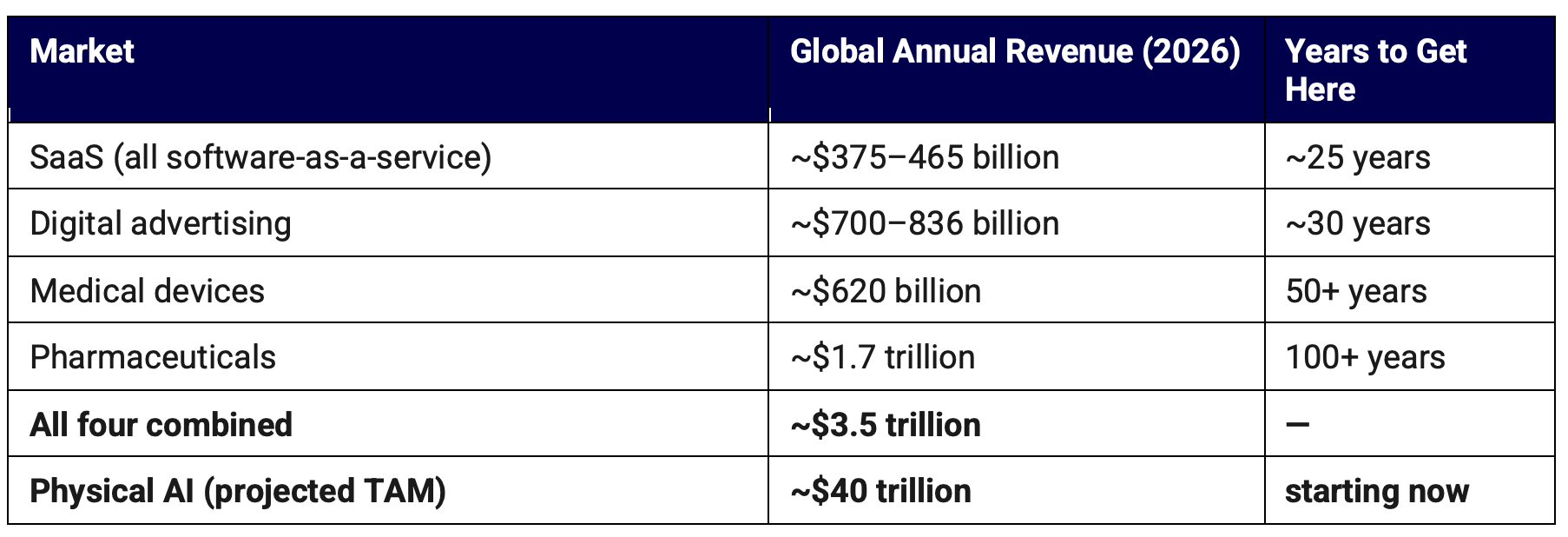
Read that again. Take every SaaS subscription on Earth, every ad served on every screen, every pacemaker and surgical robot, and every pill and vaccine sold anywhere in the world – combined, they generate less than one-tenth of the addressable market now opening in Physical AI.
Digital advertising just crossed $1 trillion in total global spend for the first time this year, and we rightly treat it as one of the great business stories of the internet era. It monetizes attention. Physical AI monetizes labor – and humanity spends far more on getting work done than on being advertised to.
This is not a knock on SaaS or biomedical. They are magnificent industries. The point is proportion: the categories that defined venture capital for a generation are rounding errors against the market Physical AI addresses.
We are at the starting line
The second recalibration is about timing. The $40 trillion is the destination; today’s odometer reads almost zero.
Actual deployed Physical AI — robots working outside of structured factory cells, in stores, streets, fields, and hospitals — generates revenue measured in the low hundreds of billions globally, with analysts projecting roughly $430 billion by 2030 and $1.6 trillion by 2040. Against a $40 trillion TAM, the market is roughly one percent penetrated. In SaaS terms, this is 1999. In digital advertising terms, this is the year before search ads existed.
The smart money has noticed. Venture funding for robotics hit $8.8 billion in a single quarter last year – a fifteen-fold increase since 2017. And three days ago, Andreessen Horowitz – the firm that spent fifteen years preaching that software would eat the world – announced a $1.1 billion fund dedicated entirely to the physical layer of AI: chips, power, data centers, and robotics. It is the firm’s first hardware-dedicated fund in its history, and it disclosed that hardware has grown from a negligible share of its deal flow to more than 20%. When the most software-committed investors on the planet raise a billion-dollar fund for atoms instead of bits, the rotation is no longer a prediction. It’s a fact.
$40 Trillion is the floor, not the ceiling
Here’s the part that even the bulls tend to miss: $40 trillion is a measure of the work humanity does today. It says nothing about the economic activity Physical AI will unleash.
Every prior general-purpose technology followed the same pattern. Electricity was sized as a replacement for gas lamps – then it created appliances, manufacturing lines, and entire industries no one had imagined. Computing was sized as a replacement for human calculators – then it created software, the internet, and the digital economy. In each case, the “replacement TAM” turned out to be the smallest part of the story, because when the cost of a fundamental input collapses, demand doesn’t just shift – it explodes into uses that were never economical before.
Physical labor is the most fundamental input there is. What happens when it becomes abundant and cheap? Buildings get inspected monthly instead of never. Farms get weeded plant-by-plant instead of sprayed field-by-field. Elder care becomes continuous instead of rationed. Groceries get picked, packed, and delivered at a cost that makes today’s e-commerce economics look primitive. None of that activity exists in today’s $40 trillion, because today it can’t be afforded. The honest answer is that nobody knows how large the unlocked economy becomes. We are in genuinely uncharted territory — and the $40 trillion is best understood as the floor of the addressable opportunity, not its ceiling.
Why this market will move faster than any before it
There’s a second reason the old mental models fail here: every previous market had to build its own engine. Physical AI gets to ride one that’s already running — and accelerating.
SaaS had to wait for broadband. Digital advertising had to wait for smartphones. Biotech waits, always, on the clock speed of biology and regulation. Physical AI, by contrast, inherits the fastest-compounding technology stack in history the moment it’s born: foundation models whose capabilities are improving on a curve that is more than exponential, compute performance that doubles and redoubles, and simulation environments where a robot can accumulate years of practice overnight. The industry’s own leaders now say the “ChatGPT moment” for robotics has already happened – the breakthrough is behind us, not ahead of us.
And Physical AI carries a compounding advantage no human workforce can match: fleet learning. When one human worker learns a skill, one worker improves. When one robot learns a skill, every robot in the fleet inherits it – instantly, permanently, at zero marginal cost. Each robot deployed makes every other robot better. That is a flywheel the industrial revolution never had, the software revolution only approximated, and it means adoption curves that took SaaS twenty-five years and pharmaceuticals a century may compress into a decade.
The last technology wave gave us a preview: a conversational AI product went from launch to a hundred million users in two months — the fastest adoption of any technology in human history. Physical AI rides that same intelligence, pointed at a market thirty times larger. Betting that this market develops on last century’s timeline is the riskiest assumption of all.
The segments that add up to $40 trillion
No single robot wins a $40 trillion market. It gets won segment by segment, each one a giant industry in its own right:
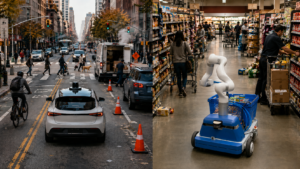
Manufacturing and assembly – the first proving ground, where structured environments meet acute labor shortages. Warehousing and logistics – already the most automated segment, with hundreds of thousands of robots deployed, and still early. Autonomous vehicles – trucking, delivery, and ride-hail, each a multi-hundred-billion-dollar labor pool. Agriculture – planting, weeding, and harvesting across the most labor-starved industry on Earth. Healthcare and elder care – where demographics guarantee demand will outrun human supply. Construction, defense, and infrastructure – dangerous, dirty, and chronically understaffed. And retail and grocery – the segment where robots finally leave the back room and work in public, alongside customers, in the stores where all of us shop every week.
That last one is ours. Grocery alone is a trillion-dollar industry in the United States, operating on razor-thin margins with some of the highest labor turnover in the economy. In-store picking – walking aisles, identifying products, handling items of every shape and fragility – is precisely the kind of unstructured, human-environment work that defines the frontier of Physical AI. It’s why we build purpose-built robots for the store itself, and why we pair AI with skilled human operators rather than waiting years for perfect autonomy. The $40 trillion doesn’t get unlocked by robots that work someday. It gets unlocked by robots that work now.
The recalibration
Every generation of investors anchors on the last generation’s winners. The anchor today is software: high margins, zero marginal cost, familiar metrics. Physical AI looks harder – it involves metal, motors, and logistics. It is harder. That’s exactly why the opportunity is 10x larger than everything the software era produced, combined, and why the firms that defined software investing are now writing billion-dollar checks for hardware.
The market being addressed is not an app category or a therapeutic area. It is work itself. Forty trillion dollars is what that work is worth today — before counting a single dollar of the economic activity Physical AI will make newly possible, and before accounting for the fact that this market rides an intelligence curve that is still bending upward. The starting gun just fired, and the track may be shorter than anyone thinks.
Sources: NVIDIA CEO public remarks on the $40–50T labor-automation TAM (2025–2026); Morgan Stanley humanoid robotics forecast; Andreessen Horowitz “Machine Age Fund” announcement, Aug 28, 2026; Barclays Impact Series on AI robotics VC funding; WARC/eMarketer global ad spend forecasts 2026; Fortune Business Insights & Precedence Research (SaaS, medical devices); Frost & Sullivan global pharmaceutical outlook 2026; ResearchAndMarkets Global Physical AI Market 2027–2040.