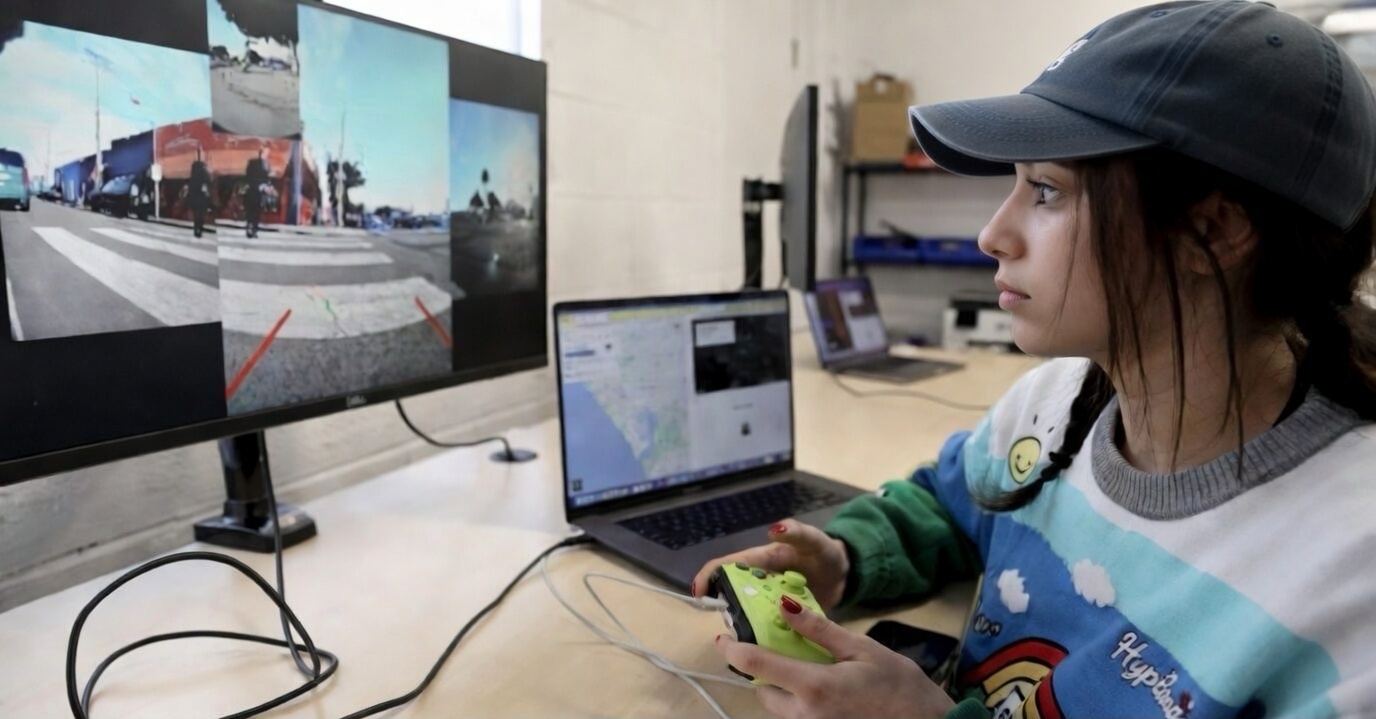
In the race to automate blue-collar tasks, full autonomy remains a distant promise, gated behind the maturation of spatial AI and commoditized hardware. Yet, businesses can’t afford to wait a decade or more for perfection. Teleoperation is where remote human operators bridge the gaps in today’s AI. It emerges as the pragmatic powerhouse, enabling immediate deployment of robotic systems in complex, real-world environments like grocery stores. By blending partial automation with human oversight, teleoperation not only delivers seamless operations from day one but also generates the invaluable training data needed to evolve toward independence. This hybrid model has propelled giants like Starship Technologies, Alphabet’s Wing, and Waymo to commercial scale, proving that teleoperation isn’t a crutch. It is the accelerator that unlocks value now while paving the road to tomorrow’s autonomy.
The critical role of real-world training data in robotic automation
Robotic systems operating in the unstructured, dynamic environments of the real-world such as a grocery store aisle filled with irregularly shaped products, varying lighting, and frequent stock changes which cannot rely on pre-programmed rules or simulations alone; they require massive volumes of high-quality, task-specific training data to learn reliable perception, grasping, and decision-making.
By initially deploying remote human operators to control our picking robot, we create a scalable data-collection flywheel that captures precisely the information needed for autonomous performance: optimal grasp points on each SKU (accounting for packaging deformation or occlusion), the most effective suction-cup configurations for different materials and weights, motion trajectories that minimize time while avoiding collisions, and learned substitution logic when a customer’s preferred item is out of stock. This approach mirrors the proven path taken in blue-collar automation from warehouse order fulfillment to last-mile delivery. Teleoperation serves as the critical bridge: humans provide the dexterity and judgment that current algorithms still lack, while every action generates labeled, real-world data that progressively trains computer-vision and manipulation models.
Full autonomy will remain out of reach until spatial AI matures and becomes commoditized, at which point the accumulated dataset will enable our robots to generalize across thousands of SKUs, store layouts, and edge cases with the speed, accuracy, and adaptability that remote operators demonstrate today.
Overcoming AI’s breakdowns for seamless real-world deployment
Teleoperation is not a temporary workaround. It is the proven, battle-tested accelerator that unlocks real-world robotic deployment today, turning imperfect AI models into immediately valuable systems while they mature. Where vision-language models and spatial AI break down in unpredictable environments: occluded objects, dynamic obstacles, edge-case substitutions, or regulatory handoffs. The remote human oversight provides seamless continuity, ensuring zero downtime and flawless customer outcomes. Pioneers and tech giants alike rely on this hybrid model precisely because it delivers commercial scale without waiting for commoditized autonomy. In grocery picking, for instance, teleoperation allows robots to handle the straightforward tasks autonomously while humans intervene remotely for navigation and picking decisions, all while collecting data to reduce interventions over time.
Real-world success stories: how teleoperation powers today’s robotics leaders
Even as autonomy advances, leading companies lean on teleoperation to deploy at scale. Here’s how it’s working in practice:
Starship Technologies: Scaling Sidewalk Deliveries with Remote Oversight
Starship Technologies, the leader in sidewalk delivery robots, has deployed fleets that have completed over 9 million autonomous deliveries with more than 2,700 robots operating across 270+ locations in seven countries, and plans to scale to 12,000 robots by 2027. Their robots are mostly autonomous, handling millions of miles and 125,000 daily road crossings safely, but remain tethered to remote operators for situations requiring human judgment, such as complex street crossings or unexpected obstacles.
This approach enabled immediate market entry years ahead of full autonomy, created a rich data flywheel to push autonomy allowing one operator to supervise dozens of robots simultaneously, expanded job access to remote workers operating safely from home, and kept services running through pandemics and network hiccups. Teleoperation has accelerated adoption while lowering R&D risk.
Alphabet’s Wing: Taking Drone Delivery to the Skies with Remote Monitoring
Google’s Wing (Alphabet) takes the same philosophy skyward in its expanding Walmart drone-delivery partnership, now scaling to an additional 150 stores in 2026, building toward a network of over 270 locations by 2027 and reaching more than 40 million Americans from Los Angeles to Miami. Their drones operate largely autonomously on beyond-visual-line-of-sight routes, flying up to 60 mph for up to 12 miles round-trip with payloads up to 5 pounds, but FAA-licensed pilots in command at dedicated Remote Operations Centers monitor the entire fleet like an air traffic control tower: performing system health checks, responding to contingencies, and using onboard cameras for final landing verification when needed.
Waymo: Remote Assistance for Autonomous Ridesharing
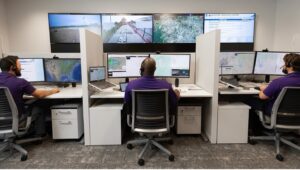
Even Waymo, Alphabet’s flagship robotaxi service maintains about 70 remote assistance agents worldwide at any time (roughly half based in two centers in the Philippines), providing real-time advice to the autonomous system for edge cases across its fleet of around 3,000 vehicles operating in six US metros, with plans for at least 10 more including London in 2026. The AI always retains final control, but the human safety net operating from four centers in Arizona, Michigan, and the Philippines enables safe, scalable operations in live traffic today, handling ambiguities without direct remote driving.
Lessons from trucking: the moment the strategy became obvious
Long before Blue Collar Robotics existed, the first spark came from a shared frustration in the trucking industry. Our two co-founders spent three years on the same team at a major truck manufacturer, watching the industry chase the hardest problem first -full autonomy- while overlooking a far more practical commercialization path: pair partial autonomy with teleoperation to deliver real value immediately.
The logic was hard to ignore. Trucking faced structural constraints that autonomy alone wasn’t going to solve quickly: persistent driver shortages, punishing over-the-road lifestyles, federally mandated hours-of-service limits (which cap how much a single driver can utilize an asset), and the cost and complexity of sleeper-cab vehicles designed around human living needs. Teleoperation reframed the entire problem. Detach the operator from the cab, and driving becomes a safer, more attractive job that can be done remotely. Multiple operators can share the same vehicle across shifts. Utilization rises. Equipment costs fall. Commercial impact shows up fast.
Yet the industry and many large organizations continued pouring hundreds of millions (if not billions) into “full autonomy” moonshots that were impressive in demos but slow to commercialize. That disconnect left a lasting lesson: when incentives reward long-horizon R&D narratives, companies can end up building technology for technology’s sake instead of deploying solutions that generate revenue and learning in the real-world.
That experience shaped the founding mindset behind Blue Collar Robotics. Rather than waiting a decade for perfect spatial AI and perfect autonomy, the team chose a model that works now: deploy with today’s autonomy where it’s strong, use teleoperation to cover the real-world edge cases, and turn every intervention into training data that steadily increases autonomy over time. In other words, don’t wait for the future to arrive – build in a way that benefits from it when it does.
Closing: two paths – we chose the one that ships
In building Blue Collar Robotics, we saw two possible strategies.
Option 1: Build a large R&D program first, invest millions into lab setups, hire a team to “collect data” in controlled environments, and hope we can simulate reality well enough before launch. That approach might produce nice demos, but it also delays learning, delays revenue, and delays the only feedback that matters: what happens in real stores with real customers.
Option 2: Deploy now with teleoperation + semi-autonomy, deliver outcomes from day one, and use every real-world pick to build the dataset that drives more automation over time.
We chose the second path – deliberately and confidently. Not because we don’t believe in autonomy, but because we do. The fastest way to reach it isn’t to wait in a lab for perfection. It’s to operate in the real-world, keep performance high with human-in-the-loop reliability, and let real work generate the learning flywheel. That’s how robotics commercializes. That’s how autonomy gets better. And that’s why we’re convinced teleoperation is the right strategy – right now.