Starting a company is never simple.
There is always risk. Always uncertainty. Always the quiet voice asking whether the idea is worth the sacrifice.
But occasionally, something different happens.
Sometimes a solution forms so clearly that once you see it, it becomes impossible to ignore. Not because it promises profit, but because it addresses a real, persistent imbalance. When that happens, the decision stops being about risk and starts being about purpose.
Do you try to shape the world in a small but meaningful way?
Or do you choose comfort and accept the quiet surrender of unrealized potential?
That is the moment when starting a company becomes hardest.
When I reach that point, I follow a rule:
I look for someone else already doing the work seriously.
If a capable company exists, my role may be to join, advise, or invest. But if no one is truly addressing the problem and the problem is real, urgent, and solvable then the responsibility comes back to me.
That is how Blue Collar Robotics began.
Lessons from China: what abundant work can do?
I spent much of my career working in Asia, particularly China. In the early 1990s, I would fly into Hong Kong and take day trips into Guangzhou, back when infrastructure was sparse and growth was just beginning.

International flight into original Hong Kong airport flying close to high rise buildings, 1992 (AI generated depiction)
Outside factory gates, long lines of people waited for work.
What struck me was not desperation – it was dignity. People dressed neatly. Tips were often refused. No one begged. Poverty, I learned, was not a measure of character. It was a measure of opportunity.
Those factories – modest by today’s standards – became engines of transformation. Within a generation, hundreds of millions of people moved into the middle class. Today, those same factories are almost unrecognizable: automated, technical, and highly productive. China is no longer just a manufacturing hub; it is one of the world’s largest consumer markets.
Abundant work changed everything.
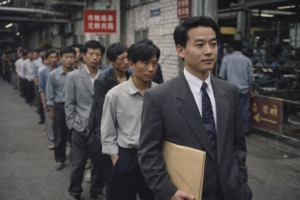
Lines outside of Chinese factories applying for work, 1992 (AI generated depiction)
A world still out of balance
Yet globally, poverty remains visible – not because people lack willingness, but because opportunity remains unevenly distributed.
When I returned to the United States in 2022 after six years localizing heavy-duty trucks for China, the contrast was striking. Labor was missing.
“Help Wanted” signs were everywhere. Restaurants were understaffed. Grocery pickup was slow. Not because people didn’t care, but because there simply weren’t enough workers.
This wasn’t new to me. Years earlier, I stood in apple orchards in Oregon watching fruit rot on the ground. Not due to lack of demand. Not due to land. Not due to food supply.
Because there was no labor.
That question stayed with me for years:
How do you move labor around the world when people themselves cannot move?
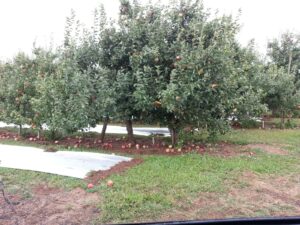
Apple orchards with rotten fruit on ground, The Gorge, Oregon, Aug 2014 (© Hank Crawford)
Why grocery became the wedge?
Back in the U.S., the answer began to crystallize during a routine grocery trip.
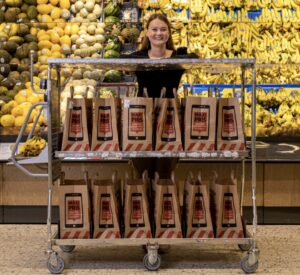
E-Grocery was exploding. Curbside pickup had become table stakes. Inside stores, armies of human pickers were fulfilling online orders.
It made sense. Grocery stores are hyper-local warehouses embedded in every community. No centralized fulfillment model can match that proximity.
But the flaw was obvious.
E-Grocery is brutally price sensitive. Labor-heavy fulfillment does not scale in a low-margin business. The economics break before adoption peaks.
China showed us the rule: when fulfillment costs fall, demand accelerates.
E-Grocery follows the same physics.
Stores still have the advantage – proximity – but only if fulfillment costs can be fundamentally restructured.
The insight: deliver labor through the internet
The question became simple:
How do you bring abundant global labor into a local store without moving people?
The answer is Blue Collar Robotics.
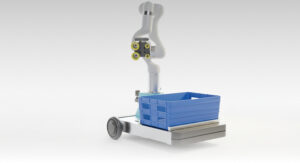
We pair mobile robotic picking devices with human-in-the-loop remote operators connected through the internet. From the store’s perspective, it looks like hiring a picker – except the picker never gets tired, never calls in sick, and improves continuously.
Our operators work in safe, comfortable environments. Physical strain disappears. Retention increases. Skill compounds.
As automation improves, each operator manages more productivity.
As productivity rises, costs fall.
As costs fall, e-Grocery scales.
This is not automation replacing people.
It is technology redistributing opportunity.
Why this matters?
Blue Collar Robotics sits at the intersection of three unstoppable forces:
• A global labor imbalance
• Explosive growth in e-Grocery
• Breakthroughs in robotics and connectivity
Together, they enable something new: Robotic Labor-as-a-Service (RLaaS).
For grocery chains, this unlocks scalable, profitable fulfillment.
For workers, it creates dignified, long-term employment without physical wear.
For employees, it means building technology that expands human opportunity.
For investors, it creates a platform that extends far beyond grocery.
And for me, it answered the question that started this journey.
Some ideas are too important not to pursue.
This is where Blue Collar Robotics began and it’s only the beginning. We’ll continue sharing what it takes to build robotics that work in the real world, alongside people, not apart from them.
We’re just getting started.
Hank Crawford, Co-Founder & CEO