We announced our service just one month ago and the response has been humbling.
People talk about product–market fit like it’s a milestone you calmly arrive at. In reality, when it happens, it grabs you by the “blue” collar and pulls you forward. Conversations accelerate. Inbound interest multiplies. Assumptions get validated faster than you can write them down. Momentum replaces persuasion.
That’s exactly where we are today.
After months of market research and quiet development, we expected the grocery industry to see the value of our solution. What we didn’t expect was how universal the need was, and how long the industry had been waiting for something this practical.
Why in-store picking hasn’t been solved already
We kept asking a simple question: If this problem is so obvious, why hasn’t it been solved already? The answer became clear fast. Most robotics efforts start with technology: full autonomy, advanced AI, or humanoids, and then hunt for a problem worthy of the complexity. The result is often impressive demos that struggle in the real world.
We did the opposite.
We studied how in-store fulfillment actually works: where time is lost, how errors happen, which decisions matter, and which ones don’t. When you do that, the solution becomes simpler, not more complex. Grocers don’t need science projects. They need reliable tools that reduce labor cost today, fit inside existing stores, and improve margins without disrupting operations. So we built quietly, resisted over-automation, and let customer pain -not hype- drive every design decision.
The market responded immediately
When we announced our solution, the response was immediate:
- Major grocery chains reached out to explore pilots
- Professionals contacted us about employment
- Investors leaned in with diligence-level questions
- Suppliers offered full technical support
- Industry experts validated both the approach and the philosophy
That kind of reaction only happens when a solution aligns with reality. To everyone who reached out, thank you! Your engagement reinforced why we’re building this company.
Customers don’t want robots – they want a solution
One message from customers has been remarkably consistent:
“We need to regain control of our e-commerce fulfillment and make it profitable.”
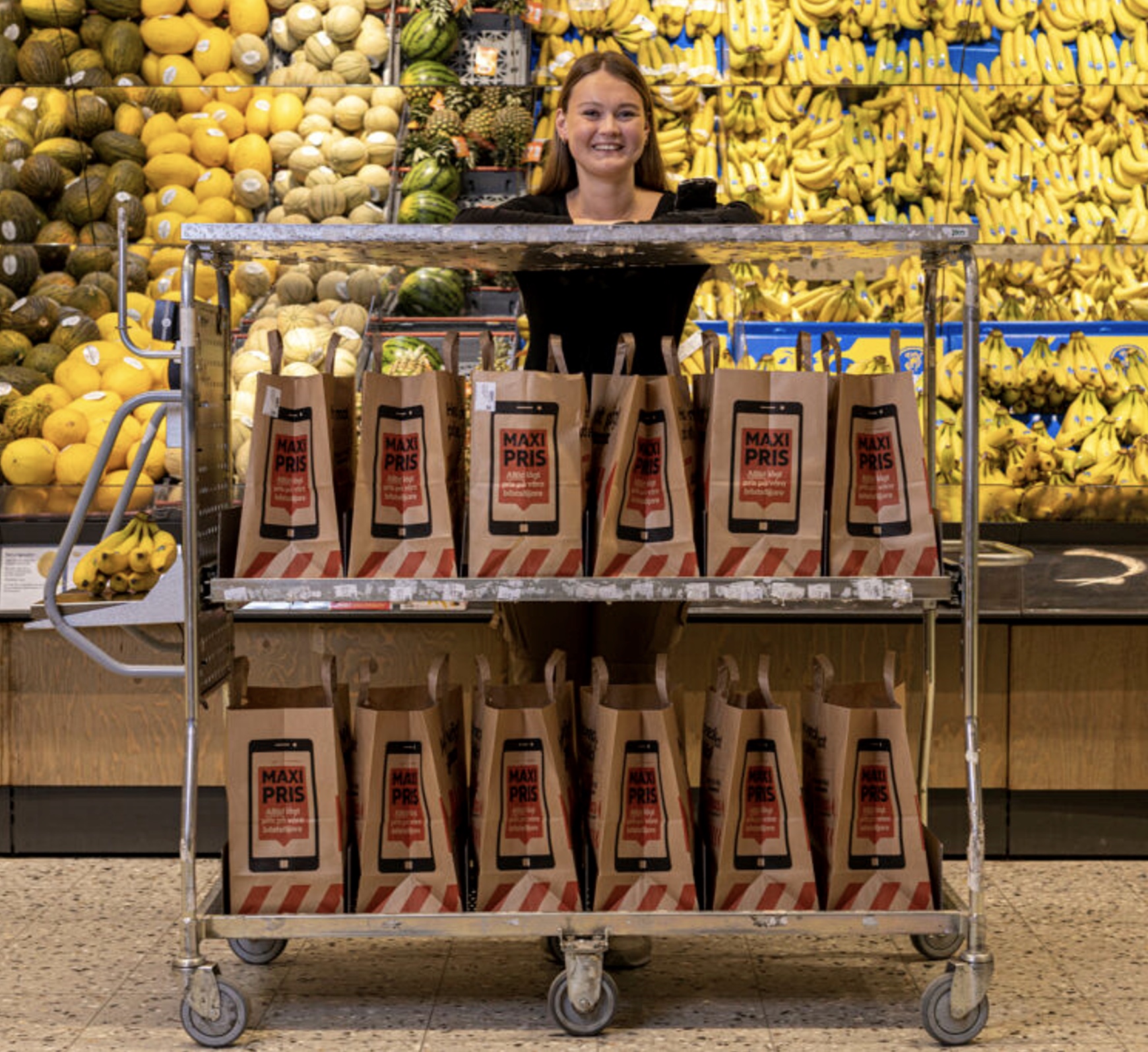
In-store picking has become one of the largest cost centers in grocery retail. Labor is expensive, hard to hire, and hard to retain. Outsourcing fulfillment erodes margins. Full automation requires massive capital and years of risk. What customers actually want is lightweight, flexible equipment that works inside existing stores and reduces labor cost per order immediately.
That’s exactly what we built.
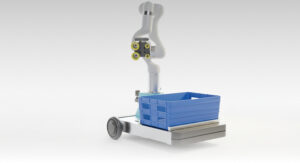
Our robots are compact, safe around shoppers, fast to deploy, and productive on day one. They allow grocers to bring fulfillment back in-house while materially improving unit economics.
Tele-operation: the enabler, not the compromise
Tele-operation is widely misunderstood.
There’s a belief that robots must be fully autonomous to be valuable. History says otherwise. Sidewalk delivery robots struggled for years until companies embraced human-in-the-loop tele-operation. Once they did, deployments scaled and millions of deliveries followed. Even moving from Point A to Point B still requires judgment in the real world. Humans provide that judgment efficiently and economically.
Grocery picking is far more complex. Robots must handle tens of thousands of unique items -different sizes, weights, packaging, and fragility- picked horizontally from shelves. In this environment, a human-in-the-loop isn’t optional; it’s essential. Our system combines a purpose-built cart, a robotic arm optimized for shelves, a specialized vacuum gripper, and a web-based operator interface that enables fast, intuitive decisions exactly when they matter.
Why humanoids are the wrong tool
Humanoids are impressive but often unnecessary.
Humans themselves are not optimized for repetitive, physically demanding tasks. Replicating the human form in a robot therefore doesn’t make technical or economic sense for grocery fulfillment. You inherit the same inefficiencies along with significant added cost and mechanical complexity.
Grocery fulfillment doesn’t require imitation of a human. It requires efficiency, accuracy, and reliability, delivered consistently and at scale.
That’s why we designed a purpose-built robotic device optimized specifically for picking designated product categories and improving unit economics in a meaningful way. From this foundation, we continue to add automation where it delivers real value.
For this class of problem, purpose-built devices win every time.
Robots in public spaces are already normal
Robots interacting with people isn’t a future concept, it’s already happening.
Autonomous ride-hailing, driverless freight testing, in-store scanning robots, and hotel delivery robots are now part of daily life. Public interaction is no longer theoretical; it’s an engineering problem that has been solved repeatedly.
Our robots are designed to be safe, predictable, and unobtrusive while moving at human-appropriate speeds and integrating naturally into store operations.
Conclusion: scaling by learning first
We’ve found a clear product–market fit in robotic in-store e-grocery fulfillment.
Our focus now is simple: increase pick speed, improve operator efficiency, and expand automation where it makes sense. Starting with tele-operation allows us to learn at scale – every pick improves the system, every deployment sharpens performance.
By doing what doesn’t scale today, we’re building what will scale tomorrow.
This is how durable robotics companies are built, and now it is getting real!