E-Grocery has grown faster than the operating models grocery stores were designed to support. Grocers are now fulfilling a meaningful share of orders inside stores built for shoppers, not for large-scale picking operations.
Automation has therefore become a central topic across the industry. But the real question is no longer whether automation is needed. It is how much automation actually makes sense and where it should be applied to improve economics without disrupting the store.
At Blue Collar Robotics, we believe the answer is not full autonomy. It is human-in-the-loop, tele-operated robotic labor – a practical approach that works in real stores today and improves fulfillment economics without rebuilding the supply chain.
The grocery store is already the warehouse
Before discussing robots, it’s worth reframing the problem.
Grocers already operate one of the most sophisticated and widely distributed fulfillment networks in the world. Stores are fully stocked, temperature-controlled, staffed, and embedded directly in local neighborhoods.
In other words, the grocery store is already the warehouse.
From an economic standpoint, in-store fulfillment already avoids the largest cost drivers of e-commerce: long-haul transportation, duplicate inventory handling, and additional cold-chain infrastructure. What remains as the dominant variable cost is labor. Improving labor productivity inside the store therefore delivers outsized impact without adding new fixed costs elsewhere in the supply chain.
Why centralized automation falls short
Centralized automated fulfillment centers are often presented as the answer. In practice, they introduce structural disadvantages.
Moving inventory further from the customer adds transportation cost, delivery latency, and operational complexity, especially for fresh and frozen items. Centralized facilities also depend on sustained, predictable volume, while grocery demand varies widely by location, time, and season.
Most importantly, centralized automation still requires labor for exceptions, substitutions, maintenance, and peak demand. Once labor re-enters the system, the economic advantage narrows rapidly while capital costs remain.
Rather than replacing the store network, centralized models duplicate investments that already exist.
Duplication is not transformation.
Why full autonomy struggles in-store
If centralized automation isn’t the answer, what about fully autonomous robots inside stores?
Grocery stores are among the most difficult environments for autonomy: layouts change constantly, aisles are narrow, shoppers behave unpredictably, and substitutions require judgment. Autonomous systems perform best in structured, static environments. Grocery stores are neither.
In mixed human settings, autonomous robots often stop, hesitate, or require wide safety buffers – ironically increasing congestion rather than reducing it.
The right amount of automation: Human-in-the-Loop
Rather than replacing humans, tele-operation decouples labor from location.
A remote operator sees through the robot, makes real-time judgment calls, and handles exceptions naturally. More importantly, that labor can be applied where and when demand exists.
Instead of labor being fixed to a single store, operators can move digitally between locations throughout the day, smoothing peaks and improving utilization across a region. This creates true labor elasticity across stores without permanently increasing headcount.
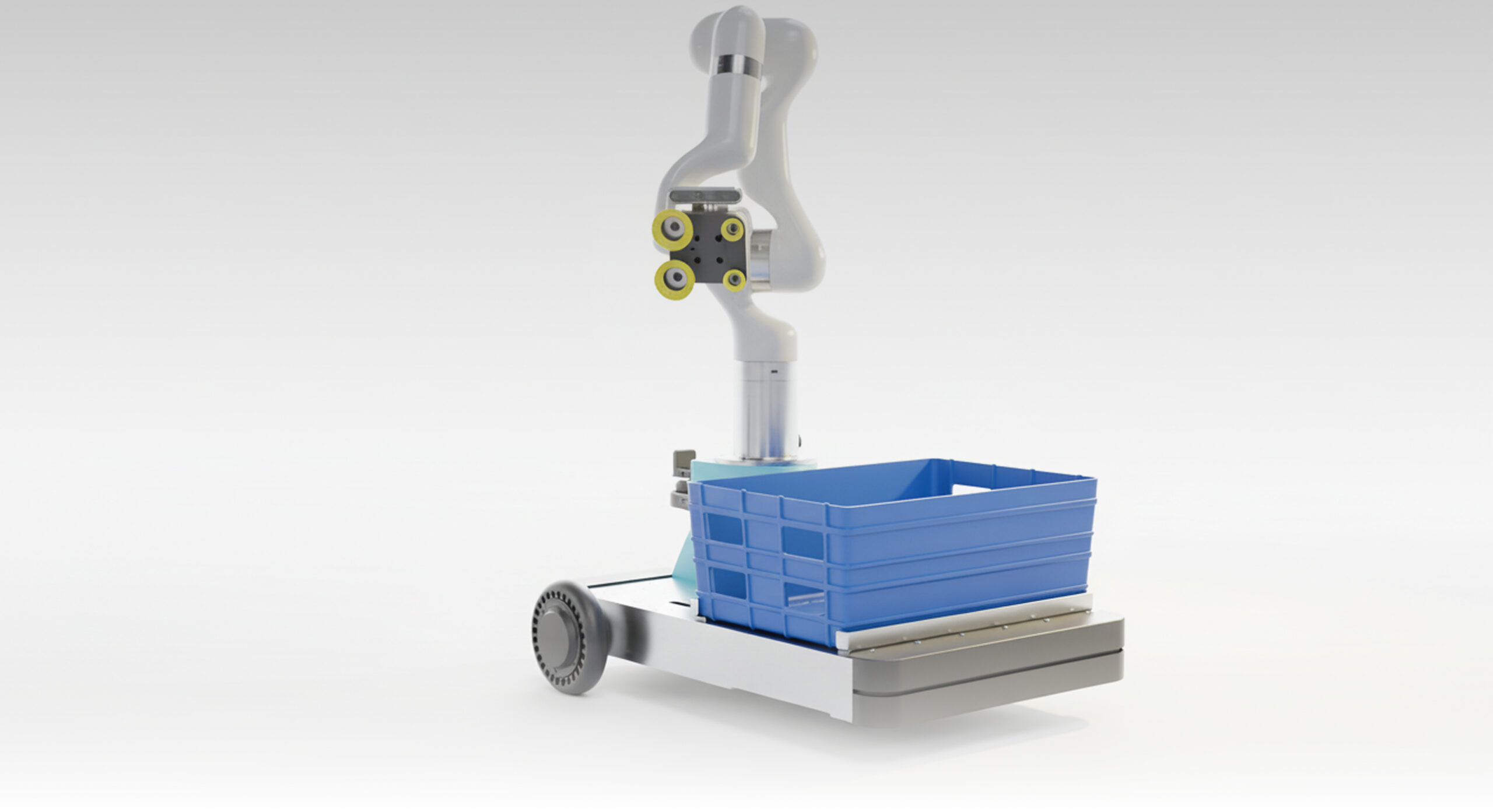
Inside the store, a tele-operated robot functions as a predictable picking unit whose performance is measured by time spent actively picking. Because a human remains in control, the system navigates socially, yields naturally to shoppers, and integrates smoothly into normal store flow.
This approach is not about reducing staff. It is about delivering each pick more efficiently and consistently, allowing stores to fulfill e-Grocery demand with clearer cost visibility while preserving human judgment where it matters most.
Where the economics improve first
Not all picking work is created equal. Center-aisle items – shelf-stable, predictable, high-SKU-count products – represent the most attractive opportunity for automation.
These items account for a large share of e-Grocery order lines and are among the most labor-intensive to pick. Even partial automation here can materially reduce labor cost per order, with savings compounding across hundreds of repetitive picks without touching higher-judgment fresh departments.
This is how automation improves unit economics incrementally, not disruptively.
Closing thoughts
The future of e-Grocery will not be defined by who builds the most autonomous robots. It will be defined by who applies the right amount of automation – automation that improves productivity, reduces in-store congestion, and works inside the assets grocers already own.
At Blue Collar Robotics, we believe the path forward is clear: build on the store, not around it. Make existing infrastructure more productive, not more complex.
That is how e-Grocery scales sustainably and how automation delivers real value in the real world.